May 11, 2026 · 12 min read
Rigorously Joyful
Notes on Active Institutional Memory.

Digital Friction
Institutions are cracking under the speed of digital acceleration. This is not new. But for a long time it was the kind of thing thinkers talked about at conferences and in research papers, then went back to their offices, wrote new papers, attended new debates. With incremental if any direct consequence in code or policy for the average user.
We need to do better, faster. In the dawn of the agentic era of systems development, language directly correlates to infrastructure. The consequences of institutional friction are no longer theoretical. The cracks are more than visible now, we are paying for them with actual mountains of gold. Those of us who are neophilic enough are watching a plural renaissance.
From code to chip design, passing through robotics, proteins, pharmacology, diagnostics. Myriad compounding S-curves make all those breakthroughs possible by seriously addressing linguistics as technology. They have also brought on a Cambrian explosion of exploits and social engineering strategies that pose existential threats to the organizational substrate that sustains us. And the most vulnerable are those whose mandate is stewardship and protection of public goods, often resource constrained in capital, humans and tech. Often led by passionate and driven operators who are nonetheless under-equipped to deal with the literal meaning of labour and agency shifting under their feet.
The speed of technological development is doing what speed does to structures: it finds the weak points and pushes through them. Organizations that were designed for a slower, more deliberate world are discovering that their coordination systems can't handle the speed and volume of the new input. The delta between data generation and data comprehension is likely to accelerate and the pressures will mount. The loosening of criteria might become a dangerously seductive solution. Emphasis on dangerous.

Undiscerning Adoption as Identity Loss
Just going with the flow will come at a price. Imagine governments that were already notoriously bad at processing information fast enough to make good decisions caving to undefined promises of automation. The generalized training of sycophantic software offered by hyperscalers will perform soft capture by speaking the dialect of price and convenience.
The most adaptable and willing will buy in by mandates of innovation and token budgets and feel enlivened by the new powers and processes while they relinquish their institutional knowledge and turn a blind eye to the ecosystem lock-in.
Reductions in personnel will force key unspoken operational principles to leave with the people that used to silently do frontline work while they get replaced by software that, unless rigorously built for uniqueness, will give their users commonplace miracles. Our tools will get generally smarter at the price of our specialized use cases getting dumber.
The problem ahead of us is: how do organizations retain what makes them special while embracing new technology? What needs to be preserved about you to keep your identity from being washed away in the generalized training of the machines that will eventually do more and more of the work? If you came here expecting a critical post on AI, I'm sorry to disappoint.
The technology is very real, and everything seems to point to the fact that the revolutions are coming. The robots, the physics breakthroughs, the insights on the nature of biology, the brain, perception itself — are coming. On horseback. Ahead of schedule even. What we will have is not a technology or adoption problem. This is a leadership problem. What is the meaning of human leadership when language and technology start to become (more obviously) the same thing?
We have an opportunity to reinterpret what leadership means and how it shapes linguistic landscapes that form our organizational identities. What allows them to succeed? Most of our institutions were built on a model where intelligence is personal. You hire smart people, you retain them, and the institution is as smart as its people. Leadership means having good judgment. Knowledge lives in the people who earned it. When they leave, it leaves with them.
Great legacies were always built by leaders who left a pattern of language behind. This used to be a challenge measured in decades, learned in hindsight. Now this becomes an existential imperative to be designed actively. Now.

What's Actually Breaking
Institutions process inputs. Proposals, requests, reports, feedback, complaints, applications, communications from partners, from members, from the public. Every one of those inputs is, in a computational sense, a program being run against the institution's operating system.
When the institution doesn't have formal standards for processing those inputs, every message becomes an interpretation problem. Different people read the same proposal differently. Context gets lost between departments. Decisions get made based on who was in the room, not what was in the document. The institution accumulates ambiguity like debt.
This is not just inefficiency anymore. Now that our interactions are increasingly mediated by machines that run on language, it becomes an actual security problem. In computer science, there's a field called language-theoretic security that studies exactly this pattern: when a system doesn't define precisely what valid inputs look like, attackers exploit the ambiguity. The gap between what the system intends to accept and what it actually accepts becomes the attack surface. The insight started in software security — every program that processes input is running programs written by whoever controls that input — but the principle scales beyond code.
Organizations face the same dynamic. When there's no formal grammar for how proposals are evaluated, or how knowledge is stored, or how decisions are documented, the institution is running on ambiguity. Often ambiguity also acts as the enabler in organizational contexts that simply cannot run without a little bit of grease. Some people rise to positions to manage the formal and informal pathways that get carved institutional fact via incentives and ritual. And we survived well enough till now. Some corruption here, some influence trafficking there. But things tend to chug along.
What happens when the people with their uncatalogued knowledge of the pathways don't show up for work anymore? When the potential for overflow increases rapidly and our ambiguities remain exploitable? Ambiguity is where things will break.
When language becomes infrastructure, especially in the case of agentic machines that navigate by semantics, the consequences of ambiguity scale. You've seen it in your repo. We will feel it society-wide soon enough. A small team can survive on informal knowledge for a while. An institution with hundreds of thousands or millions of participants may as well, at the cost of a large bureaucrat class that inevitably become royalty within that system.
But what happens once a large percentage of those participants are tireless agentic systems running at all hours, pulling at the edges of the system? We will see things break. The bigger the organization, the bigger the honey pot, the more every informal process becomes a liability. Once we set swarms of bots loose over them, the issue becomes existential.
The cracks in institutions are not about bad people or bad intentions. They're about systems that were never designed to handle the volume and complexity of inputs they will now receive. And there's no turning back.

The Power of Listening
So far, so gloomy. But the whole point I stopped prompting to sit and write this down by hand is: I believe there's something we can do about it. So what's on the other side?
I expect that in the next ten years, the skill of listening will become an organizational superpower. Not personal listening. Not the kind where a leader nods thoughtfully in a meeting. Something more structural: programmatic listening.
As our sensing and comprehension sophisticates, aided by these same systems, we can listen to more at once. Nature will speak louder. Children will speak louder. Machines and systems will speak louder. The world is producing more signal than ever. The question is whether institutions can hear it.
The new leadership will be judged by its ability to design systems that listen at the scale of the institution. Systems that retrieve knowledge from both formal records and informal experience. Systems that identify patterns across an untold number of interactions and process those patterns into alignment. This is what Palantir does for a living. And so should you.
What matters to you should be rigorously organized and available to every agent (of any kind) that should be in the know. Not just the people who happened to be in the right meeting. And designed to adapt their input surfaces dynamically, to programmatically reject that which is not aligned enough to deserve crossing the membrane.
This means listening to the power of N. Not dependent on one person's judgment. Not through surveillance. Just by pattern matching and compounding the intelligence of the whole network into a defined shape. Intelligence is not a thing you have. It's a thing you do. And like nature, it moves, it adapts, it compounds. Intelligence (and nature) are verbs. It's just easier to see them as such now.

The Fabric
When those listening systems do the work of processing inputs into structured language patterns that are navigable, the benefits compound. Institutional knowledge starts behaving like a lattice, or interconnected matrices, or a vector space. (That's how we got neural networks in the first place.)
Metcalfe's law posits "the value of a network grows with the square of its nodes" — as long as they are all interconnected. That misses the point entirely. More nodes are not "more better" — the game is context + relevance = revelation.
Stuart Kauffman calls this "the adjacent possible." Each new piece of formalized knowledge doesn't just add to the total. It brings into focus what can be discovered next. Doors that didn't exist before the question was asked are now open.
This is how institutional knowledge compounds: not by connecting everything to everything, but by bringing closer what the next question can reach. Every insight, every question, every decision that gets formalized and contextually connected to the existing body of knowledge doesn't just add to the total or multiply the value of everything already there. It helps define the shape of the discovery horizon.
Memory is irrelevant without retrieval. Retrieval within the correct context is the wedge that enables organizational authorship. When the human is allowed to do only the work that needs the human, the human will likely tend to use its tools to do what we have always done. Discovery.
Winning at leadership starts looking different. It becomes about how quickly all that is rote becomes codified. How fast suspicion becomes discovery. How efficiently discovery becomes common fact, recodified into infrastructure that enables further discovery.
What if all that matters can be seen, and all that was seen can be connected to what led to it? Knowledge, interactions, decisions and expression become fabric — tissue that connects inquiry and understanding. Comprehension and rigor can help unlock a patterned tessellation of past and future allowing for a longer and rather rich sensation of now — not a more desperate one.
Cybernetics and steerability are the bottleneck we need to address. Not intelligence. Not effort. The ability to steer collective inquiry towards functional discovery. Leaders who design extra-active listening systems (not personal "listening" but the creation of formalized knowledge accrual and processing systems) and allow networked knowledge to become an active character in organizational life can create something extraordinary: engines for both rigor and joy that run on accelerated cycles of synthesis and analysis.
Here's the kicker: the rigor isn't just for efficiency. It's also for defense. When the system knows what aligned input looks like, it can reject what doesn't belong. The same formal standards that make knowledge compound also make the institution harder to capture.

The Engine
In my 20s, a significant part of my life was teaching people how to paint. One core idea of my methodology was "synthesis and analysis don't mix."
Meaning, you cannot "make stuff up" and "judge if it's good" at the same time. First you paint. Shut up, paint. Calm your mind. Let your consciousness climb down your arm till the tip of the tool. You are the brush now. Reach the thesis / prototype / allow discovery to happen. Then, judge the living hell out of it. Cry if needed, but once done... Go again.
That loop is ever faster now. And the human might not be the core actor on either side of the engine. So where is the wedge for human action, experience and judgment in an engine of synthesis and analysis that is bot-enabled and spinning faster than eyes can read?
You get to ask questions. All the questions. Any question. You get to ask your agents to suggest what questions you should be asking. And because of how rigorously set up the system was, all that's left for you is the joy of discovery.
An engine whose fuel is the quality of our questions.
Synthesis and analysis feed each other in a loop. Every question sharpens the pattern. Every pattern surfaces better questions. Since language is infrastructure, this is not a metaphor. It's a mechanism, and it requires two things: the willingness to deepen inquiries and question everything that was assumed (ever). And an adherence to formal standards when asking questions, processing compounding answers, and forming a living corpus of organizational language.
That corpus is the engine's output and its fuel at the same time. It forms a bedrock of the organizational future, but is quickly felt in the present. An organization that tends its corpus well starts noticing something: answers arrive before questions are fully formed. The patterns are already there. Somebody asked this before, or something close enough. The corpus remembers.
Being faithful gardeners of the corpus is a new leadership competency. Not the glamorous kind. The patient, daily, unglamorous kind that compounds into something no amount of individual brilliance can replicate.
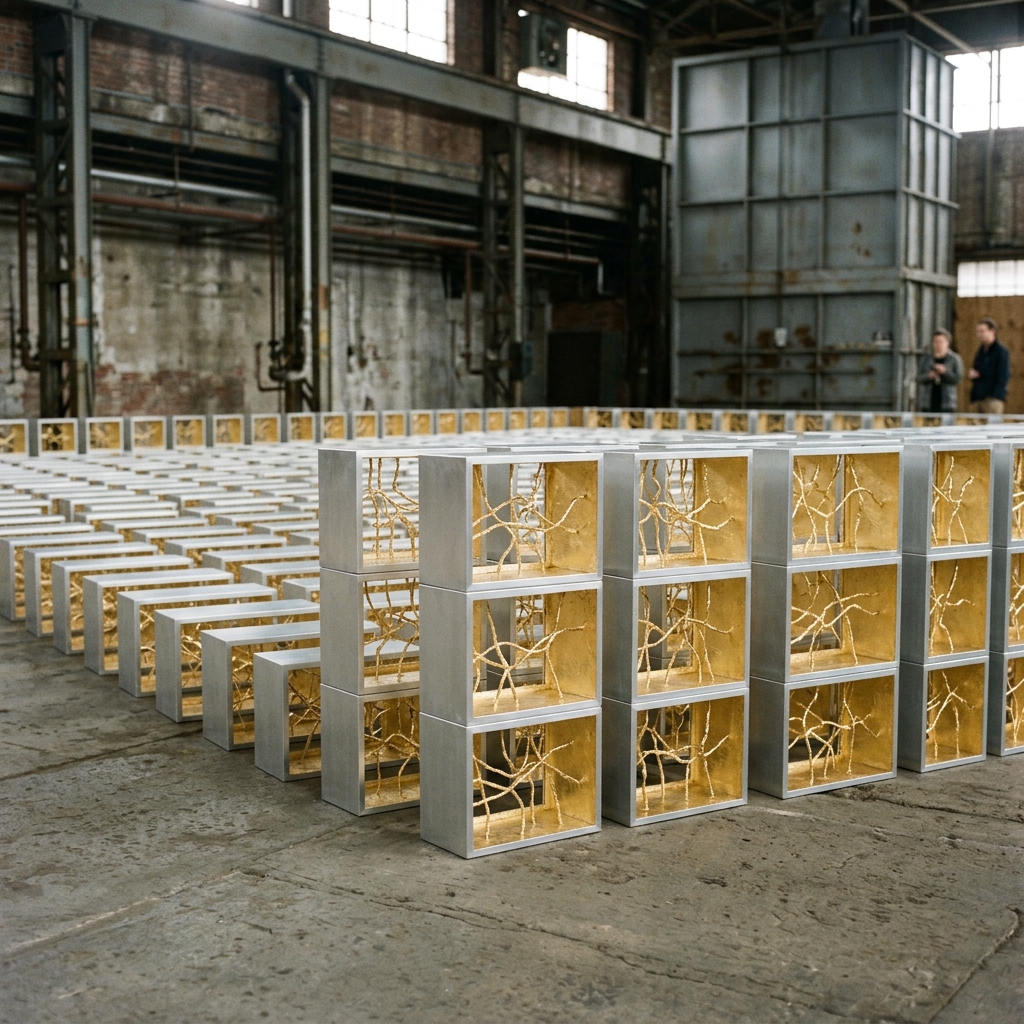
Graceful Play
This is where the title's promise gets paid: leaders who define rigorous analytical systems will unlock the joyful synthesis of new sources of value accrual, while they keep their people and their bots in sync, and win.
Read that again. It's the thesis of this entire essay.
When the rote work is codified. When the formal standards are in place. When the corpus is tended and the engine is running. What happens? The people inside the institution are freed to play. Not play as leisure. Play as strategy. Graceful play becomes a strategic mandate and a tactical wedge, because its results now have a path from exploration to production, from intuition to validation, from a hunch to market fit.
The more rigorous yet joyful bets the organization takes, the more it learns about the world, about itself, and about the living boundary between the two. That boundary is where what you know meets what you don't yet understand. Tending it honestly is how an organization discovers its own meaning for success.
This matters for any group. It matters most for groups where participation is voluntary and yet they carry the mandate of being economically productive.
A common pattern in decentralized contexts and the stewardship of public goods. In those groups, the relationship between being and becoming is not abstract. It's operational. You have to know what you are and stay open to what you could be, at the same time. Rigorous systems give you the ground to stand on. Joyful synthesis gives you a reason to keep standing.

Where Intelligence Lives
These systems are already forming. I'm just one of the builders that holds a piece of the puzzle. But adoption lag might mean that things will get worse before they get better.
I started my AI journey via skepticism, recovering from a devastating hack and the death of my mother. The process I describe in this article is literally how I remembered who I was before these events and why I got out of bed to work. A couple dozen of months of larval stage later, I became a technologist who sees a sincere promise of joyful discovery for those who are willing to accept that it comes with a sincere modicum of rigor.
There are challenges ahead. In schools redesigning how children learn to ask questions. In communities formalizing how they listen to each other. In organizations that need to stop treating knowledge as a private asset and start treating it as shared infrastructure beyond the metaphor. Some institutions will crack further. But there's very real space for connective social growth here.
What emerges from the cracks depends on our willingness to build the fabric, tend the engine, and let rigorous systems become the foundation for genuinely joyful work.
(With humans in it. Because they wanted to be there.)
You can't compete with someone who's having fun. But purpose requires maintenance.

Newsletter
Notes from the studio
Occasional writing on coordination, narrative, and governance.